
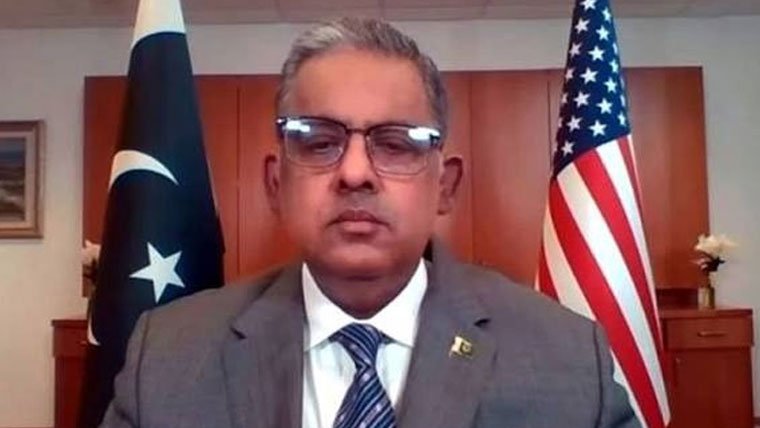
India’s Unilateral Actions Pose Serious Threat to Peace and Security in South Asia: Rizwan Saeed Sheikh
WASHINGTON:Pakistan’s Ambassador to the United States, Rizwan Saeed Sheikh, has strongly urged New Delhi to honour the 60-year-old Indus Waters Treaty (IWT) or else it would be endangering the peace and stability of South Asia.
The Pakistani ambassador wrote an analytical article in a leading American magazine that provided a detailed and reasoned response to a previous article by the Indian ambassador to the USA.
Declaring a “non-negotiable”-status for Treaty and denying any attempts to distort it.Denying attempts to distort and reaffirming the binding nature of Treaty.
Ambassador Rizwan Saeed Sheikh made it clear that India is making endless efforts to taint the framework, history, purpose and utility of the Indus Waters Treaty.
He stressed that the Indus Waters Treaty, which has been in existence since September 1960, was not a concession to Pakistan or a gesture of Indian generosity but the result of a decade of hard negotiation. He said compliance with this legal agreement is compulsory for both sides and the treaty would give India rights to the eastern rivers (Ravi, Beas, and Sutlej) and the western rivers (Indus, Jhelum, and Chenab) would go to Pakistan.
India’s description of the treaty as unfair was rejected by the ambassador, who pointed out that this ignored the historical circumstances and the compromises involved in negotiating the treaty.
The Reporting of Obstruction Allegations and Legal Stand.Reporting of Obstruction Allegations and Legal Stand.
In addition Ambassador Sheikh retorted that India’s allegations of Pakistan’s efforts to block the legitimate Indian hydro power projects were totally baseless, and that international courts and neutral experts have reaffirmed several times that hydro power projects on western rivers are bound by the stipulated structural parameters.
Under this situation, the use of dispute resolution or arbitration is not an obstruction, it is the exercise of the rights guaranteed by the treaty,” he insisted. From a legal point of view, the Indus Waters Treaty is intact, effective and legally binding for both parties.
The Pakistani envoy in the letter made it clear that any country “should not be allowed to evade its international treaty obligations through the release of irrelevant political or security charges. He stressed that a baseless claim of “terrorism” or any bilateral conflict does not give India any unilateral right to suspend, disrespect or rewrite the Indus Waters Treaty.
No such provision for unilateral withdrawal.
It was a well-established fact in the law,” he said, “that there was no mention in the Indus Waters Treaty for either party to unilaterally suspend or cancel the agreement. No one can break the agreement except the replacement of a new bilateral agreement, which is formally ratified by both governments.
Ambassador Rizwan Saeed Sheikh concluded by calling on India to honour its treaty commitments and participate in constructive dialogue through institutional and participatory channels and existing dispute resolution processes.