
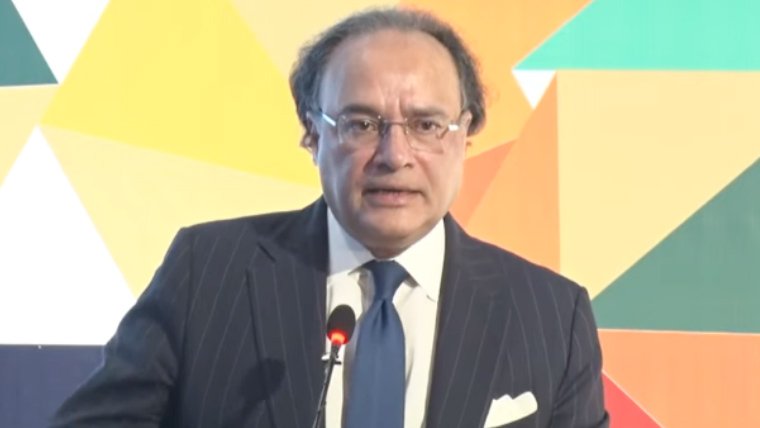
Government’s Primary Focus Lies on Boosting Investment, Exports, and Productivity, Says Finance Minister Muhammad Aurangzeb in London
LONDON: Federal Minister for Finance and Revenue Muhammad Aurangzeb has stated that the government’s core economic agenda is anchored on accelerating investment, expanding exports, and scaling up national productivity through structural reforms designed to limit the state’s footprint in the economy.
Addressing a high-profile conference organized by JP Morgan in London, the Finance Minister highlighted that over the past three years, Pakistan has steadfastly prioritized macroeconomic stabilization, resulting in substantial structural improvements across both fiscal and external sectors.
Economic Growth, Fiscal Deficit, and Investor Meetings in London
Detailing macroeconomic indicators, Muhammad Aurangzeb noted that Pakistan’s economic growth rate reached 3.7 percent in the 2026 fiscal year, while the fiscal deficit narrowed down to 2.6 percent of GDP. He added that Pakistan has successfully achieved a primary surplus for the third consecutive year, and the government is now focused on translating this hard-earned stabilization into export-led growth and productivity enhancement.
During his engagements in London, the Pakistani delegation held productive meetings with 55 global investment funds, which received briefings on Pakistan’s emerging economic prospects and expressed keen interest in the country’s reform trajectory.
Reconnection with Global Capital Markets and Privatization
The Finance Minister emphasized that Pakistan has successfully reconnected with international capital markets, pointing to overwhelming investor appetite for Panda bonds and the recent $3 billion Eurobond issuance. The government aims to maintain steady global market access, extend debt maturity profiles to mitigate refinancing risks, and further strengthen equity and corporate debt markets.
Outlining ongoing structural reforms, Aurangzeb stated that the government is systematically reducing the role of the state in commercial sectors. Progress on the privatization of Pakistan International Airlines (PIA), power distribution companies (DISCOs), and other state-owned enterprises is actively moving forward, alongside the transition of major airport operations to private sector management.
Support for SMEs, Tech Sector, and Private Capital
To foster a vibrant entrepreneurial ecosystem, the government is formulating a National Private Equity Framework while expanding credit and financial access for small and medium enterprises (SMEs), agriculture, and housing. Stressing that Pakistan’s vast domestic market and youthful demographic dividend represent major investment advantages, the minister noted that ongoing reforms encompass tax, energy tariffs, and institutional governance.
Concluding his address, Aurangzeb reiterated the vision to transition Pakistan’s economy toward technology, manufacturing, and export-driven expansion, supported by strategic integration into global trade networks and preparations to leverage blockchain and Web3 technologies.