
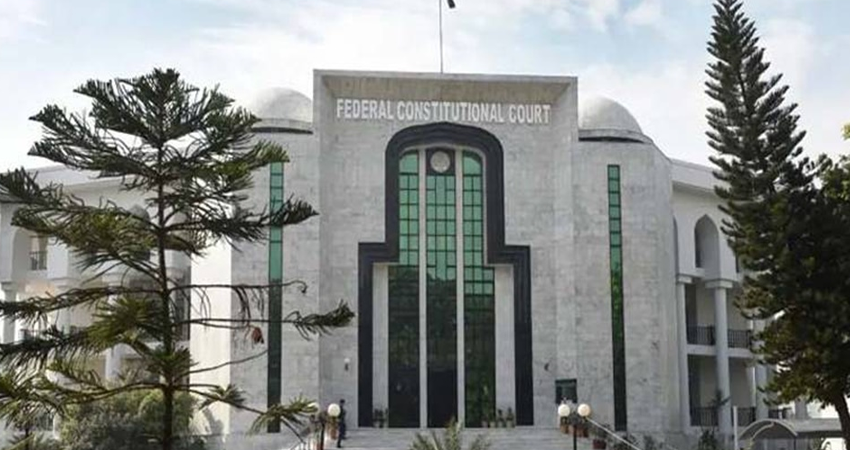
Federal Constitutional Court Orders Transfer of Founding PTI Chairman’s Hospital Case from Supreme Court, Admitting Prisoners’ Petitions
ISLAMABAD: The Federal Constitutional Court has officially accepted three petitions from prisoners who are seeking to be treated at private hospitals on equal footing with the founding PTI chairman and released its landmark order to move the hospital transfer case of former premier from the Supreme Court to the FCC.
The proceedings were conducted by a three-member bench presided by Chief Justice Amin-ud-Din Khan and Attorney General for Pakistan (AGP) was present to aid the bench.
Transfer of Case and Jurisdiction Under Article 175E
The court, during the hearing, directed the transfer of the pending application filed by the PTI in the Supreme Court relating to the transfer of the alimony case from the Supreme Court to Shifa Hospital, which will mean the apex court will no longer entertain the case. In addition, the bench directed the transfer of the related government review and contempt of court petitions.
Attorney General for Pakistan said that the constitutional court has constitutional power to call and take into its possession the case record. While accepting the points mentioned as valid, the Federal Constitutional Court instructed the records of any similar case pending at any High Court in the country to be sent to it.
Under Article 175E, sub-clause 5 of the Constitution, the court stated that it has statutory powers to call for case records from any judicial forum. Justice Ali Baqar Najafi asked if the Supreme Court should have decided on the maintainability of the petition in the first place and the Attorney General agreed, saying that a constitutional interpretation could now only be done by the Federal Constitutional Court. Justice Aamir Farooq said this issue came before them through appeal from the verdict of the Islamabad High Court, which had issued an interim order and thus the Supreme Court’s order was not final.
The Federal Constitutional Court then postponed the hearing indefinitely.